
 https://d381ib15gv5oql.cloudfront.net/wp-content/uploads/Fundraising-Tea-2026-video.jpg
717
1280
Ollie
https://d381ib15gv5oql.cloudfront.net/wp-content/uploads/Oak-Grove-School_logo.png
Ollie2026-10-11 10:49:532026-10-22 11:47:40Annual Fundraising Tea
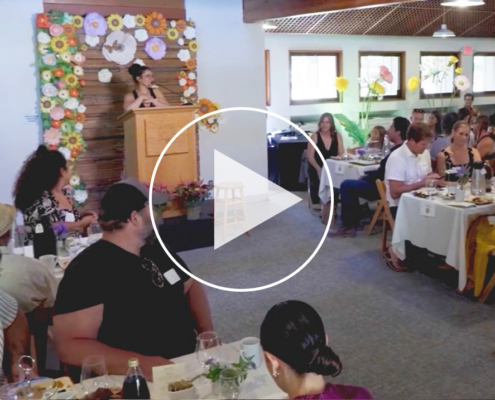
Recently, we gathered for our annual Fundraising Teas, welcoming members of the Oak Grove community for an afternoon of stories, reflection, and connection. We heard from a current senior, a parent, an alum, a teacher, a fourth grader, and a Board member, each sharing an Oak Grove experience through the lens of this year’s theme, The Living Movement of Relationship.
Those who attended may have noticed the dandelion featured in our printed materials and decorations. We chose this familiar plant as an invitation to consider the nature of relationship and how perception shapes our understanding of the world.
A dandelion can be seen as a flower or a weed. It transforms from a vibrant yellow blossom into a delicate, fluffy seed head, sometimes in just a few days. Wind, animals, or even a passing person can carry its seeds far from where it first grew. The timing of this transformation depends on sunlight, temperature, moisture, and the particular conditions surrounding the plant.
And yet, the dandelion doesn’t really become something different. The same plant moves through different forms, while what we call it changes along the way: a flower, a weed, a seed, a possibility.
Perhaps this is something of what we mean by the living part of relationship. Relationship is not static. It continually offers opportunities to discover something about ourselves, to see another person differently, and to question how we respond to conflict, difference, difficulty, and beauty.
And perhaps most importantly, relationship invites us to see that we are not separate from one another. What I do affects you. What you do affects me. When we begin to see this clearly, we understand that we are not merely observers of what happens around us. We are part of it.
And how we respond matters.
This is at the heart of Oak Grove’s educational intent.
Krishnamurti suggested that education is not simply about acquiring knowledge, but awakening awareness. Of course, we want students to learn mathematics, history, literature, science, languages, and art. But we also want them to awaken to themselves, to one another, and to the world around them.
Krishnamurti suggested that education is not simply about acquiring knowledge, but awakening awareness.
Earlier this year, School Board Chair Cathleen Lynch and I attended an educational leadership conference where Dr. Pedro Noguera, Dean of USC’s Rossier School of Education, spoke about what students will need in a world increasingly shaped by artificial intelligence. As technology advances, he emphasized the growing importance of the qualities that make us deeply human: emotional intelligence, imagination, intuition, creativity, and the capacity to understand ourselves and others.
Each of these qualities speaks directly to our capacity to be in relationship. Academic knowledge is essential to navigating the practical world, but it is through relationship that we discover what it means to be alive.
What does this ask of a school?
It asks for educators who center the student rather than academic outcomes alone, who recognize the role of anti-bias and social justice education in cultivating compassion and empathy, and who nurture curiosity and a love of learning rather than relying on extrinsic motivation and pressure. Educators who are skilled at asking profound, reflective questions, often without a single answer.
It asks that we care for the extraordinary campus, honoring the natural ecosystem and holding human structures in balance with the surrounding oak woodland. It asks for a program that takes students into the mountains, to the ocean, to India, to the Olympic forests, and into the wilderness surrounding us.
It asks that we connect field studies with service learning, cultivating an understanding of reciprocity: that we receive from the whole and bear some responsibility for tending to the whole.
And it asks all the adults in our community, parenting adults, faculty, administrators, office, maintenance, and kitchen staff, to continue learning together, questioning one another with care, and remaining attentive to the larger world and how it shapes life on our campus.
Education is not only about preparing young people to move through the world. It is about helping them see that they are part of it.
This is The Living Movement of Relationship: the ongoing process of seeing ourselves as part of something larger, understanding our impact, and becoming more sensitive to how we respond.
Our Fundraising Teas offered a beautiful reminder that Oak Grove is sustained not simply through financial generosity and through the many relationships that give this community life. Every story shared reflected this mutuality: how Oak Grove shapes the lives of students and families, and how each person, in turn, shapes the life of the school.
Thank you for being part of this living, changing community and for the many ways you help Oak Grove thrive, today and for generations to come.
Recent Blog Posts:
https://d381ib15gv5oql.cloudfront.net/wp-content/uploads/Fundraising-Tea-2026-video.jpg
717
1280
Ollie
https://d381ib15gv5oql.cloudfront.net/wp-content/uploads/Oak-Grove-School_logo.png
Ollie2026-10-11 10:49:532026-10-22 11:47:40Annual Fundraising Tea https://d381ib15gv5oql.cloudfront.net/wp-content/uploads/High-School-Community-Agreement-Wordcloud.jpeg
960
1280
Ollie
https://d381ib15gv5oql.cloudfront.net/wp-content/uploads/Oak-Grove-School_logo.png
Ollie2026-09-28 12:54:562026-09-29 18:48:07Beginnings of Learning
 https://d381ib15gv5oql.cloudfront.net/wp-content/uploads/High-School-students-trail.jpeg
960
1280
Ollie
https://d381ib15gv5oql.cloudfront.net/wp-content/uploads/Oak-Grove-School_logo.png
Ollie2026-09-25 11:10:122026-10-29 16:24:13Our theme for the 2026-27 school year
Latest News
 The Living Movement of RelationshipOctober 29, 2026 - 4:54 pm
 Annual Fundraising TeaOctober 11, 2026 - 10:49 am
 Beginnings of LearningSeptember 28, 2026 - 12:54 pm
 Our theme for the 2026-27 school yearSeptember 25, 2026 - 11:10 am
 Peace is Not the Absence of ConflictSeptember 23, 2026 - 3:49 pm
Each year, we choose an annual theme that invites us to pause and reflect on our deepest purpose. This year, we have chosen the theme “The Living Movement of Relationship.” In this short video, students and faculty share their reflections on the theme and how it connects to their experiences at Oak Grove School.
#theartoflivingandlearning #oakgroveschoolojai #jkrishnamurti

The Lizards are headed to the CIF playoffs! 🦎🏐
After winning the Condor League, the Oak Grove Girls Volleyball team will travel to Irvine this Wednesday for a 5 pm playoff match vs TVT Community Day School.
If you’re in the area or up for making the drive, come help us cheer on the Lizards!
#bumpsetspike #theartoflivingandlearning #oakgroveschoolojai #jkrishnamurti
Join us for Open House on Saturday, November 7th, and enjoy campus tours, a complimentary vegetarian lunch, meetings with faculty in open classrooms, student exhibits, and live entertainment. Always such a joyful day filled with community spirit!
Please RSVP at: https://oakgroveschool.org/open-house/ (link in bio). See you here!
#theartoflivingandlearning #jkrishnamurti #oakgroveschoolojai
Our 9th-grade Environmental Science and 10th-grade Biology students headed into the field this week for the first visit in a new partnership with Ojai’s Turtle Conservancy. Through fieldwork, guest speakers, and classroom learning, students are excited to explore our local ecology while contributing to the Conservancy’s work through service learning. ❤️ 🐢
@turtleconservancy #highschoolojai #highschoolscience #turtleconservation #servicelearning #conservation #naturelovers
1 week ago